


The Sur Empire (1540-1555 AD), though brief in its duration, represents a critical and dynamic period in the history of Indian art and architecture. Founded by the formidable Sher Shah Suri after his usurpation of the Mughal Empire under Humayun, the Sur interregnum was far from a mere hiatus in Mughal rule. Instead, it served as a vital bridge between the early Mughal style, exemplified by Babur and Humayun, and the mature, grandiloquent style perfected by Akbar and his successors. The Surs, particularly Sher Shah, initiated a distinct architectural idiom characterized by monumental scale, robust simplicity, and a synthesis of indigenous Indian and imported Islamic forms. Their patronage resulted in the creation of tombs, mosques, and infrastructural projects that were both utilitarian and powerful statements of political authority.
Sher Shah’s reign was marked by incessant military campaigns and ambitious administrative reforms. His architecture reflected this pragmatic yet visionary mindset. Unlike the Mughals, who often emphasized paradisiacal gardens and ethereal elegance, Sur architecture was designed to project an image of solid, indomitable power. It was an architecture of proclamation, intended to legitimize the rule of a new dynasty of Afghan origin by embedding its presence permanently into the landscape of North India. The primary patrons were Sher Shah and his successor and Islam Shah, with their most significant contributions being their own mausoleums and the rebuilding of the Purana Qila in Delhi.
The Sur style can be distinguished by several key features:
- Sur buildings are overwhelmingly large monumental and imposing. They prioritize a massive, awe-inspiring presence over delicate ornamentation.
- The designs are geometric, robust, and often lack the complex articulation of later Mughal buildings. The focus is on the purity of form and is marked by large domes, towering arches, and vast walls.
- The Sur structures primarily used locally available grey quartzite and red sandstone, with sparing use of marble for accents. The effect is one of sheer strength and durability.
- Sher Shah, an Afghan, brilliantly synthesized the architectural traditions of the Delhi Sultanate (specifically the Lodis) with Hindu and Jain elements from the region, and the emerging Persianate tastes of the Mughals. This created a uniquely Indian Islamic style.
- The Sur period in its innovativeness perfected the octagonal plan for tombs and introduced the concept of a grand, free-standing mausoleum set within a large artificial lake.
Major Architectural Elements of Sur Monuments
Some of the Structural Elements associated with Sur Architecture are:
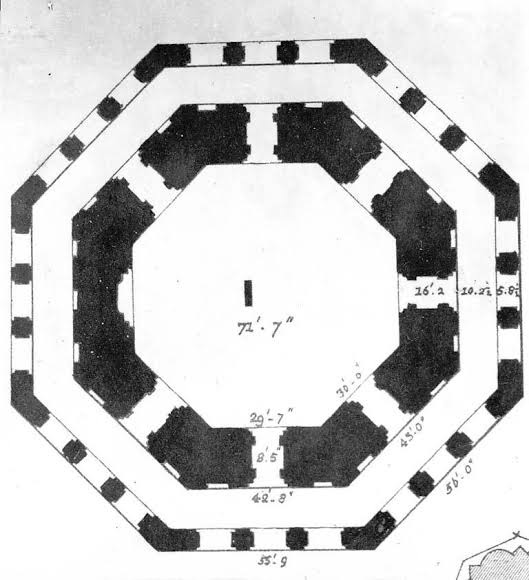
a) The Octagonal Plan (Hasht Bihisht) which was the single most significant contribution of Sur architecture. While the Lodis used octagonal tombs, the Surs perfected and monumentalized the form. The plan consists of a central domed chamber surrounded by eight sides, which can be chambers, vaulted bays, or arched openings.
It allowed for a more dynamic and faceted exterior than a simple square plan. It provided a graceful transition from a square base to a circular dome through the use of squinches in the corners of the octagon. This plan was used most famously in the tombs of Sher Shah and Islam Shah in Sasaram.
This plan was directly adopted by the Mughals and reached its zenith in Humayun’s Tomb in Delhi, commissioned by his wife after the Mughal return, clearly inspired by Sur prototypes.
b) The Domed Chattri (Kiosk)
Small, domed kiosks supported by pillars or columns. They are a quintessential indigenous Indian architectural element, commonly found in Hindu and Jain architecture.
The Surs used them extensively as decorative crowning elements, placed at the corners of roofs, parapets, and on the drums of large domes. Their integration symbolized the synthesis of Indian and Islamic traditions. They break the stark lines of the monuments and add a delicate counterpoint to the massive domes.
c) The Massive Hemispherical Dome
Sur domes are characterized by their immense size, perfect hemispherical or slightly pointed profile, and stark simplicity. They are often built of sandstone and later whitewashed or finished with marble panels.
The primary function was to create a monumental, awe-inspiring silhouette that dominated the landscape. The dome of Sher Shah’s tomb is one of the largest in India pre-dating the Mughal era. They project an image of solidity, power, and permanence.
d) The Robust Pier and Arch System
Walls are incredibly thick, and arches are massive and sturdy rather than elegantly delicate. The arches are usually simple, high, and slightly pointed, designed for load-bearing rather than ornamentation.
This reflects the military and pragmatic nature of Sher Shah’s rule. The architecture feels fortified and indestructible, mirroring the character of its patron.
Decorative and Symbolic Elements
a) The “Star of David” / Hexagram Motif
This is a six-pointed star formed by two interlocking equilateral triangles. It is a very common and prominent decorative motif in Sur architecture, found in pierced stone screens (jalis), on spandrels of arches, and as a freestanding decorative element.
It is crucial to understand this is not a Jewish symbol in this context. In Indian architecture, this symbol is ancient and known as the Shatkona.
· In Hindu/Buddhist/Jain iconography, it represents the union of male ( Shiva, upward triangle) and female (Shakti, downward triangle) principles, symbolizing creation and the divine union.
· In Islamic geometry, it is a common non-figurative pattern representing the interconnectedness of creation and the universe. Its use by the Surs is a perfect example of the syncretic nature of their art, adopting a potent indigenous symbol and re-contextualizing it within Islamic decorative grammar.
b) The “Guldasta” (Ornamental Finial)
· Description: These are large, lotus-bud-shaped stone finials that crown the domes and chattris. They are often made of sandstone or marble.
· Significance: The lotus is another deeply symbolic element in Indian art, representing purity and divine birth. Its use atop Islamic mausoleums again shows the seamless blend of cultural motifs.
c) Carved Stone Jalis (Pierced Screens)
Intricate screens carved from single sheets of stone. The patterns are geometric, featuring the hexagram, octagrams, and other complex interlocking designs.
· Function & Significance: They served a functional purpose by allowing for light and ventilation in the inner chambers while maintaining privacy. Their intricate beauty provided a stark textural contrast to the otherwise massive, plain walls.
d) Calligraphic Bands
Bands of exquisite calligraphy, often in flowing Thuluth script, carved in relief on sandstone or marble. These bands typically feature verses from the Quran, especially around doorways and on the exterior faces of tombs.
They served a religious purpose, invoking blessings and verses of mercy for the deceased. They also functioned as a major decorative element, adding a linear, flowing quality to the solid stone surfaces.
Type of Arch
While not as varied or highly developed as in later Mughal architecture, the primary arch used in Sur buildings is the Simple Pointed Arch (or Two-Centred Arch)
This is a very robust and straightforward arch. Its shape is formed by two arcs that meet at a distinct, sharp point at the apex. The curves are usually based on a simple geometric construction rather than a complex multi-centred one.
· Characteristics: It is broad, tall, and has a very wide span. The impression it gives is one of strength and stability. The spandrels (the spaces between the arch and the rectangular frame around it) are large and were often decorated with medallions, carved patterns, or the aforementioned hexagram motif. Excellent examples can be seen in the entrance and mihrab arches of the Qila-i-Kuhna Mosque in Delhi’s Purana Qila.
In summary, Sur architecture is defined by its monumental scale, robust and simple forms (large domes, thick walls, pointed arches), and a masterful synthesis of decorative motifs (Shatkona/Star of David, lotus finials, chattris) from both Islamic and rich indigenous Indian traditions. This created a powerful and distinct style that directly paved the way for the grandeur of Mughal architecture.
Major Architectural Projects and Their Ground Plans
- The Purana Qila (Old Fort), Delhi
Sher Shah’s most ambitious urban project was the rebuilding of Dinpanah, the city founded by Humayun, which he renamed Shergarh. The Purana Qila is its surviving citadel.
The fort is roughly rectangular in plan, with massive battered walls and massive bastions. The main structures inside are:
2. Qila-i-Kuhna Mosque (1541): A masterpiece of Sur architecture. Its ground plan is a rectangular prayer hall, 51.20m by 14.90m. It is divided into five bays, each crowned by a dome. The central bay is the largest, emphasized by a lofty arch. The plan is straightforward and functional, focusing on providing a large, unified space for congregation.
3. Sher Mandal: An octagonal, two-storeyed tower built of red sandstone. Its ground plan is a simple, symmetrical octagon. It is believed to have been intended as a library or personal observatory for Sher Shah, though Humayun later used it for a similar purpose.
The Purana Qila exemplifies the military and utilitarian aspect of Sur architecture, while the mosque within it showcases their elegant religious design.
4. Tomb of Sher Shah Suri, Sasaram, Bihar
This is the magnum opus of Sur architecture and one of the most spectacular tombs in India. It represents the zenith of their architectural innovation.
The tomb is situated in the middle of a large, artificial lake, accessed by a causeway. This setting was inspired by pre-Islamic Eastern Iranian traditions and the Hindu/Jain practice of placing sacred structures in water, symbolizing purity and separation from the mundane world.
The plan is a perfect octagon. This was a significant development from the square plans of Lodi tombs. The octagon allowed for a more dynamic and faceted exterior and a smoother transition to the circular base of the dome.
The massive structure rises in three distinct tiers:
- The Base: A large, stepped plinth that emerges from the water.
- The Main Octagon: The primary structure housing the cenotaph. Each side of the octagon is punctuated by a massive arch. Smaller chhatris (domed kiosks) are placed at each corner of this level.
- The Dome: A gigantic, hemispherical white marble dome crowns the structure, sitting on a low drum. Its immense size and perfect form are the tomb’s most dominant features.
The synthesis of styles is evident: the octagonal form and dome are Islamic, while the chhatris and intricate jail screens are indigenous Indian elements. The ground plan, an octagon within a square water tank, is a powerful geometric composition that creates a majestic and serene memorial
5. The Tomb of Islam Shah
Built by Islam Shah for himself, this tomb is located near his father’s but is significantly different.
The tomb follows an octagonal plan like Sher Shah’s but is located on a high rocky plateau, not in a lake. Its most distinctive feature is its double-dome structure. The external dome is high and pointed, while an internal dome of lesser height creates the ceiling over the main chamber. This was a major technical innovation, allowing for a grand external profile while maintaining harmonious internal proportions. The ground plan is thus more complex, designed to support this sophisticated engineering feat. The exterior is more austere, reflecting the troubled times of Islam Shah’s reign.
Other Notable Constructions
Rohtas Fort, Pakistan: A massive defensive fortress built by Sher Shah to suppress the Gakhars and thwart a potential Mughal return. Its immense scale and purely military function, with miles of walls and monumental gates, further underscore the utilitarian and strategic side of Sur patronage.
Serai(s) (Inns): As part of his administrative reforms, Sher Shah built a network of serais (caravanserais) along major trade routes. These were large, square-walled enclosures with quarters for travelers, merchants, and animals, showcasing his commitment to public works and infrastructure.
Art and Decoration under the Surs
While architecture was the primary focus, decorative arts flourished within these structures. The decoration was typically restrained and bold, complementing the massive architecture rather than overwhelming it.
Extensive use of carved calligraphic bands, particularly in thuluth script, quoting verses from the Quran. Geometric patterns and stylized floral motifs were carved into sandstone and marble.
Though less common than under the Mughals, evidence of blue, green, and yellow glazed tiles used for embellishment exists, showing Persian influence.
Paintings: While no major Sur manuscript tradition is known to have survived, the blend of Persian and Indian styles that characterized early Mughal painting (like the Hamzanama begun under Akbar) likely had its roots in the ateliers that continued to operate under Sur patronage.
Conclusion
The Sur dynasty’s contribution to Indo-Islamic art and architecture is profound and disproportionate to its short lifespan. Sher Shah Suri was not merely a successful military strategist but also a visionary builder. He and his son moved away from the tentative experiments of the early Mughals and established a confident, monumental, and distinctly synthetic style. By perfecting the octagonal tomb plan, innovating with the double dome, and integrating indigenous elements into a fundamentally Islamic framework, they provided a direct and robust prototype for the Mughals to build upon. When Akbar returned to power, he did not erase the Sur legacy; he absorbed it. The grandeur of Humayun’s Tomb in Delhi, commissioned by Akbar, is unthinkable without the precedent of Sher Shah’s tomb in Sasaram. Thus, the Surs were not interlopers but essential catalysts, whose architecture forged a crucial link in the evolution of one of the world’s most celebrated architectural traditions.

 Rezavi & ASHA’s History & Archaeology Blog