The Architectural Legacy of the Surs

Tomb of Shershah

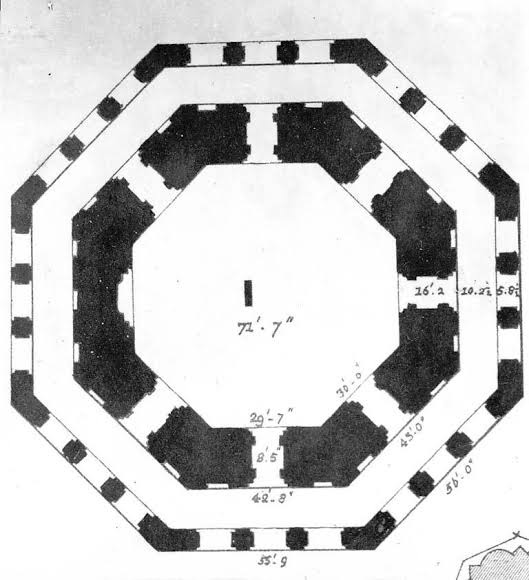
The plan

The Sur Empire (1540-1555 AD), though brief in its duration, represents a critical and dynamic period in the history of Indian art and architecture. Founded by the formidable Sher Shah Suri after his usurpation of the Mughal Empire under Humayun, the Sur interregnum was far from a mere hiatus in Mughal rule. Instead, it served as a vital bridge between the early Mughal style, exemplified by Babur and Humayun, and the mature, grandiloquent style perfected by Akbar and his successors. The Surs, particularly Sher Shah, initiated a distinct architectural idiom characterized by monumental scale, robust simplicity, and a synthesis of indigenous Indian and imported Islamic forms. Their patronage resulted in the creation of tombs, mosques, and infrastructural projects that were both utilitarian and powerful statements of political authority.

Sher Shah’s reign was marked by incessant military campaigns and ambitious administrative reforms. His architecture reflected this pragmatic yet visionary mindset. Unlike the Mughals, who often emphasized paradisiacal gardens and ethereal elegance, Sur architecture was designed to project an image of solid, indomitable power. It was an architecture of proclamation, intended to legitimize the rule of a new dynasty of Afghan origin by embedding its presence permanently into the landscape of North India. The primary patrons were Sher Shah and his successor and Islam Shah, with their most significant contributions being their own mausoleums and the rebuilding of the Purana Qila in Delhi.

The Sur style can be distinguished by several key features:

  1. Sur buildings are overwhelmingly large monumental and imposing. They prioritize a massive, awe-inspiring presence over delicate ornamentation.
  2. The designs are geometric, robust, and often lack the complex articulation of later Mughal buildings. The focus is on the purity of form and is marked by large domes, towering arches, and vast walls.
  3. The Sur structures primarily used locally available grey quartzite and red sandstone, with sparing use of marble for accents. The effect is one of sheer strength and durability.
  4. Sher Shah, an Afghan, brilliantly synthesized the architectural traditions of the Delhi Sultanate (specifically the Lodis) with Hindu and Jain elements from the region, and the emerging Persianate tastes of the Mughals. This created a uniquely Indian Islamic style.
  5. The Sur period in its innovativeness perfected the octagonal plan for tombs and introduced the concept of a grand, free-standing mausoleum set within a large artificial lake.

Major Architectural Elements of Sur Monuments

Some of the Structural Elements associated with Sur Architecture are:

a) The Octagonal Plan (Hasht Bihisht) which was the single most significant contribution of Sur architecture. While the Lodis used octagonal tombs, the Surs perfected and monumentalized the form. The plan consists of a central domed chamber surrounded by eight sides, which can be chambers, vaulted bays, or arched openings.


It allowed for a more dynamic and faceted exterior than a simple square plan. It provided a graceful transition from a square base to a circular dome through the use of squinches in the corners of the octagon. This plan was used most famously in the tombs of Sher Shah and Islam Shah in Sasaram.


This plan was directly adopted by the Mughals and reached its zenith in Humayun’s Tomb in Delhi, commissioned by his wife after the Mughal return, clearly inspired by Sur prototypes.

b) The Domed Chattri (Kiosk)

Small, domed kiosks supported by pillars or columns. They are a quintessential indigenous Indian architectural element, commonly found in Hindu and Jain architecture.


The Surs used them extensively as decorative crowning elements, placed at the corners of roofs, parapets, and on the drums of large domes. Their integration symbolized the synthesis of Indian and Islamic traditions. They break the stark lines of the monuments and add a delicate counterpoint to the massive domes.

c) The Massive Hemispherical Dome

Sur domes are characterized by their immense size, perfect hemispherical or slightly pointed profile, and stark simplicity. They are often built of sandstone and later whitewashed or finished with marble panels.


The primary function was to create a monumental, awe-inspiring silhouette that dominated the landscape. The dome of Sher Shah’s tomb is one of the largest in India pre-dating the Mughal era. They project an image of solidity, power, and permanence.

d) The Robust Pier and Arch System

Walls are incredibly thick, and arches are massive and sturdy rather than elegantly delicate. The arches are usually simple, high, and slightly pointed, designed for load-bearing rather than ornamentation.


This reflects the military and pragmatic nature of Sher Shah’s rule. The architecture feels fortified and indestructible, mirroring the character of its patron.

Decorative and Symbolic Elements

a) The “Star of David” / Hexagram Motif

This is a six-pointed star formed by two interlocking equilateral triangles. It is a very common and prominent decorative motif in Sur architecture, found in pierced stone screens (jalis), on spandrels of arches, and as a freestanding decorative element.

It is crucial to understand this is not a Jewish symbol in this context. In Indian architecture, this symbol is ancient and known as the Shatkona.


· In Hindu/Buddhist/Jain iconography, it represents the union of male ( Shiva, upward triangle) and female (Shakti, downward triangle) principles, symbolizing creation and the divine union.
· In Islamic geometry, it is a common non-figurative pattern representing the interconnectedness of creation and the universe. Its use by the Surs is a perfect example of the syncretic nature of their art, adopting a potent indigenous symbol and re-contextualizing it within Islamic decorative grammar.

b) The “Guldasta” (Ornamental Finial)

· Description: These are large, lotus-bud-shaped stone finials that crown the domes and chattris. They are often made of sandstone or marble.
· Significance: The lotus is another deeply symbolic element in Indian art, representing purity and divine birth. Its use atop Islamic mausoleums again shows the seamless blend of cultural motifs.

c) Carved Stone Jalis (Pierced Screens)

Intricate screens carved from single sheets of stone. The patterns are geometric, featuring the hexagram, octagrams, and other complex interlocking designs.
· Function & Significance: They served a functional purpose by allowing for light and ventilation in the inner chambers while maintaining privacy. Their intricate beauty provided a stark textural contrast to the otherwise massive, plain walls.

d) Calligraphic Bands

Bands of exquisite calligraphy, often in flowing Thuluth script, carved in relief on sandstone or marble. These bands typically feature verses from the Quran, especially around doorways and on the exterior faces of tombs.

They served a religious purpose, invoking blessings and verses of mercy for the deceased. They also functioned as a major decorative element, adding a linear, flowing quality to the solid stone surfaces.

Type of Arch

While not as varied or highly developed as in later Mughal architecture, the primary arch used in Sur buildings is the Simple Pointed Arch (or Two-Centred Arch)

This is a very robust and straightforward arch. Its shape is formed by two arcs that meet at a distinct, sharp point at the apex. The curves are usually based on a simple geometric construction rather than a complex multi-centred one.
· Characteristics: It is broad, tall, and has a very wide span. The impression it gives is one of strength and stability. The spandrels (the spaces between the arch and the rectangular frame around it) are large and were often decorated with medallions, carved patterns, or the aforementioned hexagram motif. Excellent examples can be seen in the entrance and mihrab arches of the Qila-i-Kuhna Mosque in Delhi’s Purana Qila.

In summary, Sur architecture is defined by its monumental scale, robust and simple forms (large domes, thick walls, pointed arches), and a masterful synthesis of decorative motifs (Shatkona/Star of David, lotus finials, chattris) from both Islamic and rich indigenous Indian traditions. This created a powerful and distinct style that directly paved the way for the grandeur of Mughal architecture.

Major Architectural Projects and Their Ground Plans

  1. The Purana Qila (Old Fort), Delhi

Sher Shah’s most ambitious urban project was the rebuilding of Dinpanah, the city founded by Humayun, which he renamed Shergarh. The Purana Qila is its surviving citadel.

The fort is roughly rectangular in plan, with massive battered walls and massive bastions. The main structures inside are:


2. Qila-i-Kuhna Mosque (1541): A masterpiece of Sur architecture. Its ground plan is a rectangular prayer hall, 51.20m by 14.90m. It is divided into five bays, each crowned by a dome. The central bay is the largest, emphasized by a lofty arch. The plan is straightforward and functional, focusing on providing a large, unified space for congregation.


3. Sher Mandal: An octagonal, two-storeyed tower built of red sandstone. Its ground plan is a simple, symmetrical octagon. It is believed to have been intended as a library or personal observatory for Sher Shah, though Humayun later used it for a similar purpose.

The Purana Qila exemplifies the military and utilitarian aspect of Sur architecture, while the mosque within it showcases their elegant religious design.

4. Tomb of Sher Shah Suri, Sasaram, Bihar

This is the magnum opus of Sur architecture and one of the most spectacular tombs in India. It represents the zenith of their architectural innovation.

The tomb is situated in the middle of a large, artificial lake, accessed by a causeway. This setting was inspired by pre-Islamic Eastern Iranian traditions and the Hindu/Jain practice of placing sacred structures in water, symbolizing purity and separation from the mundane world.
The plan is a perfect octagon. This was a significant development from the square plans of Lodi tombs. The octagon allowed for a more dynamic and faceted exterior and a smoother transition to the circular base of the dome.


The massive structure rises in three distinct tiers:

  1. The Base: A large, stepped plinth that emerges from the water.
  2. The Main Octagon: The primary structure housing the cenotaph. Each side of the octagon is punctuated by a massive arch. Smaller chhatris (domed kiosks) are placed at each corner of this level.
  3. The Dome: A gigantic, hemispherical white marble dome crowns the structure, sitting on a low drum. Its immense size and perfect form are the tomb’s most dominant features.
    The synthesis of styles is evident: the octagonal form and dome are Islamic, while the chhatris and intricate jail screens are indigenous Indian elements. The ground plan, an octagon within a square water tank, is a powerful geometric composition that creates a majestic and serene memorial

5. The Tomb of Islam Shah

Built by Islam Shah for himself, this tomb is located near his father’s but is significantly different.

The tomb follows an octagonal plan like Sher Shah’s but is located on a high rocky plateau, not in a lake. Its most distinctive feature is its double-dome structure. The external dome is high and pointed, while an internal dome of lesser height creates the ceiling over the main chamber. This was a major technical innovation, allowing for a grand external profile while maintaining harmonious internal proportions. The ground plan is thus more complex, designed to support this sophisticated engineering feat. The exterior is more austere, reflecting the troubled times of Islam Shah’s reign.

Other Notable Constructions

Rohtas Fort, Pakistan: A massive defensive fortress built by Sher Shah to suppress the Gakhars and thwart a potential Mughal return. Its immense scale and purely military function, with miles of walls and monumental gates, further underscore the utilitarian and strategic side of Sur patronage.

Serai(s) (Inns): As part of his administrative reforms, Sher Shah built a network of serais (caravanserais) along major trade routes. These were large, square-walled enclosures with quarters for travelers, merchants, and animals, showcasing his commitment to public works and infrastructure.

Art and Decoration under the Surs

While architecture was the primary focus, decorative arts flourished within these structures. The decoration was typically restrained and bold, complementing the massive architecture rather than overwhelming it.

Extensive use of carved calligraphic bands, particularly in thuluth script, quoting verses from the Quran. Geometric patterns and stylized floral motifs were carved into sandstone and marble.


Though less common than under the Mughals, evidence of blue, green, and yellow glazed tiles used for embellishment exists, showing Persian influence.


Paintings: While no major Sur manuscript tradition is known to have survived, the blend of Persian and Indian styles that characterized early Mughal painting (like the Hamzanama begun under Akbar) likely had its roots in the ateliers that continued to operate under Sur patronage.

Conclusion

The Sur dynasty’s contribution to Indo-Islamic art and architecture is profound and disproportionate to its short lifespan. Sher Shah Suri was not merely a successful military strategist but also a visionary builder. He and his son moved away from the tentative experiments of the early Mughals and established a confident, monumental, and distinctly synthetic style. By perfecting the octagonal tomb plan, innovating with the double dome, and integrating indigenous elements into a fundamentally Islamic framework, they provided a direct and robust prototype for the Mughals to build upon. When Akbar returned to power, he did not erase the Sur legacy; he absorbed it. The grandeur of Humayun’s Tomb in Delhi, commissioned by Akbar, is unthinkable without the precedent of Sher Shah’s tomb in Sasaram. Thus, the Surs were not interlopers but essential catalysts, whose architecture forged a crucial link in the evolution of one of the world’s most celebrated architectural traditions.

Mughal Architecture in India: Techniques, Inspirations and Influences

Aerial view of Fathpur Sikri

•Syed Ali Nadeem Rezavi

Aligarh Society of History and Archeology [ASHA]

From the analysis of the actual builders as mentioned in our sources as well as some modern works done on them by the present author, amongst others, it becomes clear that the architects and engineers, who planned and designed the buildings were generally Central Asians, Iranians or Timurids, whereas the “master-craftsmen” like the masons, bricklayers, carpenters and others, if not all non-Muslims, were generally Indians. This was bound to have impact on the architecture that they jointly created.

New techniques of building construction and new building materials were introduced by the time that Mughal Empire came to be established.[1] The constructional principle applied in India before the Ghurian conquest of the late twelfth and thirteenth centuries was trabeate, in which all spaces were spanned by means of beams laid horizontally. Through this technique, the resultant structures would be flat-roofed and low. No building or open-halled structure could be constructed without raising the roofs to excessive heights through stepped inclining walls (as in śikhara).[2] Heaviness, not lack of durability, was the consequence of trabeate architecture. Built of heavy building material, generally stone, they would also not be in need of mortar or cementing material: the law of gravitational pull would help in holding them together.

This had, during the Sultanate period been replaced by the arcuate technique with its consequent use of bricks and lime mortar. The use of these new building materials: the lime-mortar, gypsum, surkhī and the brick which they helped to bind, led to cheaper costs of construction. There was a proliferation in the building constructional activity. With cheaper costs, men of lesser means could also indulge in the luxury of building activity. Thus if previously only public structures and places of worship were generally constructed, now a large variety of buildings, both religious (mosques, temples, tombs, Khānqahs) and secular (palaces, sarāis, bazars and residential structures, works of hydraulics etc) sponsored both by king and laity resulted.

Some other aspects of Mughal Architecture worth our consideration include the digging of foundations and the techniques of lifting stones and other heavy material and their transportation from one place to another.

From Shāhjahān’s reign we have some information as to how the foundations were laid to give a firm base to the superstructures, especially on river-fronts. At the time of laying the foundation, the chief architects, the muhandis and/or the mi‘mār first chalked out the plan on the ground and then the diggers (bēldār) excavated the foundations to considerable depths.[3] The foundations of the Tāj Maḥal were “built of stone (sang) and [watertight] mortar (saruj).”[4] Abū Ṭālib Kalīm gives us the details of how the foundation near the river bank was laid out:

Since there is sand where there is a river, it is difficult to lay down foundations: As sand is removed, it fills in again.

They dig a well (chāh) to manage the work and firmly set in wood, all the while taking out sand from inside until they reach the solid ground below.

This well they fill up with stones and iron up to the surface.

Another well is similarly sunk nearby in the same fashion so that the building may be erected on them, which rises like a mountain.[5]

From this it is clear that the foundations were secured through double-well constructions, each cased with wood and filled with rubble and iron and bound with a leak-proof mortar. Such wells filled with rubble were not only encountered during the excavations of the Archaeological Survey of India on the foundations of the Tāj Maḥal[6], but have also been encountered during subsequent surveys and explorations at a number of places along the river at Agra.[7]

As far as the lifting of heavy building material and transporting large blocks of stone is concerned, it appears that the Mughal architects resorted to certain techniques which probably had been in existence at least from the late fourteenth century.

A perusal of the Mughal miniatures depicting constructional activity fails to provide any evidence of the use of wheel barrows or pulleys, which latter however are witnessed in Persian miniatures. The simplest way of lifting weights was through wicker-baskets carried on labourer’s heads climbing the wooden ramps.[8] But there is no depiction of the capstan nor that of a pulley in the Mughal miniatures. However we do hear of a device, jarr-i saqīl, which was used for dragging, hoisting or hauling heavy objects.[9] Was this just a general term for a device or was it a technique for lifting heavy objects? Or was it indeed the ‘capstan’ which was being referred thus? When Jahangir ordered the re-erection of an Aṣokan Pillar at Allāhabād Fort, and had his inscription put over it, his engineers would have certainly used a device other than a ramp to erect a 40 to 50 ton heavy and 10.7 m long pillar.

We have some evidence regarding this from a manuscript of an anonymous text, Sīrat-i Fīruzshāhi copied and illustrated in 1002 AH / 1593-94 AD during the reign of Akbar.[10] The series of illustrations in this manuscript not only explain the text, but show capstans being used to lift and transport the heavy stone pillars.[11] The text applies the term charkh for these capstans. Their use and depiction in this illustrated text is not surprising as we know that capstans had been used in the operation of military devices known as manjanīq (mangonel or trebuchet). These machines were first used by the Chinese in 5th-6th Century. The first image of such a machine originates from a wall painting in the Pendzhikent palace in Central Asia in Samarqand, and dates back to the end of the 7th or the beginning of the 8th century. It depicts a human-operated machine employing a sling.[12] The most important surviving technical treatise on these machines is Kitāb anīq fi al-Manajanīq (An Elegant Book on Trebuchets), written in 1462 AD by Yūsuf ibn Urunbugha al-Zaradkash. One of the most profusely illustrated Arabic manuscripts ever produced, it provides detailed construction and operating information. These writings are particularly significant because they offer a unique insight into the applied mechanics of pre-modern societies.[13] This mechanical device consisted of a wooden beam pivoted on a wooden stand. The short arm of the beam has a counterweight put on it, while the long arm had a sling suspended at its far end which carried the missile or projectile which was usually in the form of a large piece of stone. In the hands of the Mongols a winch or a capstan had been added to it which made it possible for lesser number of men to pull down the long arm. Probably this was the type of the machine which was used in the battle of Sind during the thirteenth century.[14] A drawing by Thomas Bowrey and a description of a hauling of ship during repairs in 1679 at Narsapur in Coastal Andhra also brings to light the use of ‘crab’, which was a form of capstan and tackles which are used to concentrate hauling power by slowing down the movement.[15] This device has also not been mentioned by any of the contemporary indigenous sources.

The series of illustrations of Sīrat-i Fīruzshāhi also depict boats and carts which were used to carry heavy loads from one place to another. Manrique, who witnessed the construction of the building of the Tāj Mahal in 1640-41 too mentions the use of the bullock cart to transport the building blocks:

Some of these blocks, which I met on the way…were of such unusual size and length that they drew the sweat of many powerful teams of oxen and of fierce-looking, big-horned buffaloes, which were dragging enormous, strongly made wagons, in teams of twenty or thirty animals.[16]

From the Akbarnāma paintings we come to know that once these heavy slabs arrived on the construction site, they were sectioned with the help of iron wedges and sledgehammers.[17] The double-page illustration of the Construction of the Agra Fort depicts not only a bullock-cart bringing a heavy slab, but also the process of cleaving and splitting of the stone slabs with the use of hammers and iron wedges, as well as the wooden ramp on which labourers are shown carrying heavy blocks with the help of rope slings tied to bamboo poles. They support themselves using a walking stick.

It was not that the local artisans, engineers and architects were only learning from the newcomers. A number of scholars like E.B. Havell have emphasized the indigenous influences and sources for the emerging architecture. To Havell, the mihrāb was a Buddhist loan of the niche to Islam. Even the term butkhāna used by the Arabs for the temples was a corruption of ‘Bud-khāna’ or Buddha-house.[18] In fact he went on to argue that the ‘Saracenic’ art which came to India had been Indianized before it crossed the Indus.[19] Thus the bulbous dome, as at the Tāj Mahal, was a derivation from the Buddhist Stupa tradition.[20]

The recent scholarship on Mughal Architecture can be broadly divided into two ideological groups: One, which like Havell emphasise the indigenous influences and sources, and the other, to whom the Medieval Indian architecture was basically derived from Persian and Central Asian traditions.

The first group may be represented by the voluminous contributions of R. Nath and R. Balasubramaniam amongst others. According to the former, the source of architectural design and elements was the ancient Indian knowledge as ingrained in the śilpasāstras and other traditional texts.[21] To Balasubramanium, a dimensional analysis of Mughal monuments, like the Tāj Mahal reveal a modular planning executed using traditional measurement units mentioned in the Arthaśāstras.[22] This may be so, as the actual builders of these monuments, the master-masons and stone-cutters were generally indigenous craftsmen.[23] To Balasubramaniam an analysis of the measurements at the Mughal monuments like the Tāj Mahal point to the fact that the team of architects were well versed in the civil engineering tradition of the subcontinent. The measurements at the Tāj accord with the measures listed by Kautilya, with aṅgulam considered constant at 1.763 cm. [24]

Ebba Koch, Catherine Asher and a number of others have laid emphasis on the foreign sources as inspirations for the Medieval Indian Architecture. To Ebba Koch, while the Mughal Architecture was a supremely confident style created through a synthesis of heterogeneous elements (viz. Trans Oxanian, Timurid, Indian, Persian and European), its sustaining element, especially during its initial phase, was Timurid.[25] She went on to make a study of the symbolic forms and motifs.

Indo-Muslim architecture, as it developed in medieval India, heavily borrowed stylistic, idiomatic (characteristic forms, architectonic and decorative), axiomorphic (forms appropriate to the purpose of the structure) and aesthetic traditions from Iranian, Trans-Oxanian and regional Indian styles. This borrowing was much heavier after the establishment of the Mughal dynasty. Mughal architecture bor­rowed extensively from the Delhi Sultanate, Sharqi, Gujarat, Malwa, Bengal and Rajasthani styles, as well as from styles abroad, so much so that it has itself been defined as a synthesis of these foreign and indigenous styles.[26]

Extracted from the Sectional Presidential Address by Professor Syed Ali Nadeem Rezavi given to Medieval India Section, Indian History Congress JNU session, 2014


[1] For details see S. Ali Nadeem Rezavi, “Medieval Indian Architecture: Its History and Evolution”, Symposium: History of Visual Arts-Architecture, Sculpture and PĀ’intings, Symposia Paper 29, Indian History Congress 73rd Session, Mumbai, 29 December 2012

[2] This technique of upright posts supporting the horizontal lintels or beams was basically derived from timber constructions. To make the construction more firm, brackets were employed. See Charles Fabri, An Introduction to Indian Architecture, Bombay, 1963, p.13

[3] Muhammad Salih Kanboh, Amal-i Sālih, Ghulam Yazdani, Bib.Ind., Calcutta, 1912-46, vol. III, p. 21, Abdul Hamid Lahori, Padshahnama, ed. Kabiruddin Ahmad, Abdur Rahim & W.N. Lees, Bib. Ind., Calcutta, 1867-68, vol. I, p. 223

[4] Lahori, op.cit., I, p. 223

[5] Abu Talib Kalim, Pādshāhnāma, Ms. Ethe, BL 1570, f. 116a

[6] Indian Archaeological Review (1957-58), p. 83 & Indian Archaeological Review (1958-59), p. 95

[7] Ebba Koch, The Complete Taj Mahal, op.cit., pp. 22-81

[8] See for example, ‘The Construction of Agra Fort’, Akbarnama, V & A Museum, London, no. IS-2-1896, f. 46/117; ‘Construction of Fathpur Sikri’, Akbarnama, V & A Museum, London, no. IS-2-1896, f. 91/117

[9] Abul Fazl, Akbarnama, vol. II, Bib Ind, Calcutta, 1873, p. 337; Amal-i Salih, op.cit., III, p. 38

[10] Sīrat-i Fīruzshāhi, Ms. Khuda Bakhsh Oriental Library, Patna, facsimile edition, 1999, ff. 91(b) – 105(b)

[11] For a detailed discussion on this issue, see S. Ali Nadeem Rezavi, “Medieval India: The Relocation of Ashokan Pillars by Firuzshah Tughluq”, Proceeding of the Indian History Congress, 70th Session, Delhi, 2009-10, Kolkata, 2010, pp. 994-1010

[12] H. Nickel, The Mutual Influence of Europe and Asia in the Field of Arms and Armour – Companion to Medieval Arms and Armour, ed. D. Nicole,  The Boydell Press, Rochester, 2002, p. 124; See also Paul E. Chevedden, “Artillary in Late Antiquity: Prelude to the Middle Ages”, in The Medieval City under Siege, ed., Ivy A. Corfis and Michael Wolfe, Boydell Press, Suffolk, 1995

[13] Paul E. Chevedden, Les Eigenbrod, Vernard Foley and Werner Soedel, “The Tribuchet”, Scientific American, Special Issue The Science of War: Weapons, February, 2002, online issue no. 3

[14] Ali Kufi, Chachnāma, tr. Mirza Kalich Beg, Commissioner’s Press, Karachi, 1900. See Irfan Habib, Technology in Medieval India c. 650-1750, Being no. 20 of The Peoples History of India Series, New Delhi, 2008, p. 88

[15] Thomas Bowrey, A Geographical Account of Countries Round the Bay of Bengal, 1669 to 1679, ed. RC Temple, Cambridge, 1905. Cf. Irfan Habib, Technology in Medieval India, op.cit., pp. 58, 114-15

[16] Sebastien Manrique, Travels of Fray Sebastien Manrique, 1629-1643, transl., C.E.Luard & H.Hosten, vol. II, Hakluyt Society, London, 1927, p. 172

[17] See ‘The Construction of Agra Fort’, Akbarnama, V & A Museum, London, no. IS-2-1896, ff. 45- 46/117

[18] EB Havell, Indian Architecture: Its Psychology, Structure, and History from the First Muhammadan Invasion to the Present Day, London, 1913, pp.5-6

[19] Ibid., p. 11

[20] Ibid., pp. 23-24

[21] See for example R. Nath, Colour Decoration in Mughal Architecture, Bombay, 1970; idem, History of Decorative Art in Mughal Architecture, 1976; idem, Some Aspects of Mughal Architecture, New Delhi, 1976; idem, History of Mughal Architecture (2 vols.), New Delhi, 1982-85

[22] R. Balasubramanium, “New Insights on Metrology during the Mughal Period”, Indian Journal of History of Science, 2008, no. 48, pp. 569-88; idem, “New Insights on the Modular Planning of the Taj Mahal”, Current Science, 2009, vol. 97, no. 1, pp. 42-49

[23] See S. Ali Nadeem Rezavi, “Marks and Symbols of Professionals on Mughal Monuments”, in Himanshu Prabha Ray (ed.), Sacred Landscapes in Asia: Shared Traditions, Multiple Histories, New Delhi, 2007, pp. 107-67; See also S. Ali Nadeem Rezavi, Fathpur Sikri Revisited, OUP, New Delhi, 2013, pp. 176-202

[24] R. Balasubramanium, “New Insights on Metrology during the Mughal Period”, Indian Journal of History of Science, 2008, no. 48, pp. 569-88

[25] Ebba Koch, Ebba Koch, Mughal Architecture: An Outline of its History and Development (1526-1858), Prestel-Verlag, Munich, 1991 (reprint Delhi, 2014), p.14

[26] See, for example, Ebba Koch, Mughal Architecture: An Outline of its History and Development (1526-1858), Prestel-Verlag, Munich, 1991(reprint, Delhi, 2014); and Catherine B. Asher, Architecture of Mughal India, being Vol. I, pt. 4 of’ The New Cambridge History of India, Oxford University Press, 1995. See also Lisa Golombek, ‘From Tamerlane to the Taj Mahal’, in Essays in Islamic Art and Architecture in Honor of Katherina Otto-Dorn,(ed.) Abbas Daneshwari, Malibu, 1981 (reprinted in Monica Juneja, Architecture in Medieval India, New Delhi, 2001, pp. 315-27).

Dogs: Are they Dirty, Prohibited Animals in Islam?

“You would think they were awake, when they were in fact asleep. We turned them to the right side and the left side, while their dog stretched his arms in their midst”

Qur’ān, 18:18

It is traditional among Muslims all over the world to regard the dog as a dirty animal that when touched would void the wudu (ablution) and infect the one who touched it with “nagasah” (dirty impurity)!

Recently the Turkish actor, Engin Altan, who so remarkably played the role of semi-mythical Ertugrul in the mega serial Diliris Eltugrul, has been severely trolled for having a pet dog! The comments and trolling sadly reflect not only ignorance but also misconceptions about religion of Islam.

Sadly, this concept of dog being a dirty animal comes from fabricated hadith which claims that the Prophet ordered the killing of dogs and gave numerous hadith that prohibit the keeping of dogs except for hunting and guarding, due to their dirty status!

However, by studying the Quran we find no such truth. No where in the Quran are dogs prohibited, nor is there any mention of any contaminating effect of these lovely animals who are man’s best friend. Consequently, we must dismiss all these hadith that fabricate lies against the Prophet.

1- God tells us in the Quran about the story of the dwellers of the Cave (Surah 18). In verse 13 God tells us that they were good believers and that God guided them. In verse 18 God tells us that they had their dog with them.

Now if dogs are prohibited and dirty, would God speak of those dwellers of the Cave (who had a dog) as good believers?

2- In verse 5:4 God tells us that it is okay to eat what the trained dogs catch (dogs are used in hunting). Now if the dog is an animal which causes contamination by mere touch, would God tell us it is perfectly okay to eat what the dog catches with his mouth (let alone just touch the dog)?

3- The Quran contains a very important rule for all believers, and the rule is:

Nothing is haram (unlawful) unless it is prohibited by God Himself, and since God describes the Quran as complete, perfect and fully detailed, thus all the prohibitions decreed by God are found in the Quran. The following Quranic verses confirm this truth:

“Say, “Who prohibited the nice things God has created for His creatures, and the good provisions?” Say, “Such provisions are to be enjoyed in this life by those who believe. Moreover, the good provisions will be exclusively theirs on the Day of Resurrection.” We thus explain the revelations for people who know.” 7:32

“Shall I seek other than God as a source of law, when He has revealed to you this book fully detailed?” 6:114

“You shall not utter lies with your own tongues stating: “This is halal (lawful), and this is haram (unlawful),” to fabricate lies and attribute them to God. Surely, those who fabricate lies and attribute them to God will never succeed.” 16:116

There is not one verse in the Quran where God says that dogs are dirty or that they are prohibited to keep.

4- Is it logical that God would create an animal to be man’s best friend and serve him in many ways, and then prohibit such an animal?

5- If this is what the Quran has to tell us about the issue of dogs, then where does all the prohibition come from? Where do the claims that dogs are dirty animals which if touched would void our ablution and render us impure come from? As most other corruptions which have crept into Islam, the source is always the fabricated hadith which are falsely attributed to prophet Muhammad!

Hunting dogs and the dog of the Companions of al-Kahf (Arabic: الـكـهـف‎, the Cave) are described in a positive light, and the companionship of these dogs is mentioned with approval. The Qurʼan, thus, contains not even a hint of the condemnation of dogs found in certain Hadith, which the majority of scholars regard to be “pre-Islamic Arab mythology” and “falsely attributed to the Prophet” anyways.

Hadith tell us that the Prophet prohibited the keeping of dogs as pets. Other hadith tell us that angels won’t enter a room where there is a dog. Other hadith tell us that if we touch a dog our ablution is void and we become impure, and that we have to wash seven times to clean this impurity, the final time in dust. That seems inconsistent with the Quran saying you may eat what they catch for you! Some other hadith go even beyond that to say that we must kill all black dogs!

The following are some examples:

Malik’s Muwatta, Book 54, Number 54.5.13:

“Malik related from Nafi from Abdullah Ibn Umar that the Messenger of God ordered all dogs (other than sheepdogs or hunting dogs) to be killed”.

Ibn Hanbal’s collection: The Messenger of God said:

“You shall kill all black dogs, because they are devils.”

The question is: Did the Prophet really issue these prohibitions? In addition, did the Prophet have the authority to issue these prohibitions?

The answer is given in the Quran:

“O you prophet, why do you prohibit what God has made lawful in order to please your wives? God is Forgiver Merciful” 66:1

Obviously God did not include the words in 66:1 in the Quran to belittle the Prophet in our eyes, but these words are placed in the Quran in order to confirm to all believers across all time that the Messenger of God does not have the authority to prohibit anything which is not prohibited by God. God is the only Law Maker (6:114) and the only duty of the messenger is to deliver God’s message (5:92).

Kalb is theArabic term for dog and there are different views regarding it in the traditions.

The Sunni Maliki school of Islamic jurisprudence distinguishes between wild dogs and pet dogs, only considering the saliva of the former to be impure; on the other hand, some schools of Islamic law consider dogs as unclean (najis). The historian William Montgomery Watt states that Muhammad’s kindness to animals was remarkable, citing an instance of Muhammad while traveling with his army to Mecca in 630  AD, posting sentries to ensure that a female dog and her newborn puppies were not disturbed. Muhammad himself prayed in the presence of dogs and many of his cousins and companions, who were the first Muslims, owned dogs; the Mosque of the Prophet in Medina allowed dogs to frolic about in Muhammad’s time and for several centuries afterwards.

In “two separate narrations by Abu Hurayrah, the Prophet told his companions of the virtue of saving the life of a dog by giving it water and quenching its thirst. One story referred to a man who was blessed by Allah for giving water to a thirsty dog, the other was a prostitute who filled her shoe with water and gave it to a dog, who had its tongue rolling out from thirst. For this deed she was granted the ultimate reward, the eternal Paradise under which rivers flow, to live therein forever.” The Qur’an (Surah 18, verse 9-26) praises the dog for guarding the Seven Sleepers fleeing religious persecution; Islamic scholar Ingrid Mattson thus notes that “This tender description of the dog guarding the cave makes it clear that the animal is good company for believers.”

Hazrat Umar, the second Caliph of Islam, said that if a dog was hungry in his kingdom, he would be derelict of his duty. According to the Qur’an the use of hunting dogs is permitted, which is a reason the Maliki school draws a distinction between feral and domesticated dogs―since Muslims can eat game that has been caught in a domesticated dog’s mouth, the saliva of a domesticated dog cannot be impure. Abou El Fadl “found it hard to believe that the same God who created such companionable creatures would have his prophet declare them ‘unclean'”, stating that animosity towards dogs in folk Islam “reflected views far more consistent with pre-Islamic Arab customs and attitudes”. Furthermore, “he found that a hadith from one of the most trustworthy sources tells how the Prophet himself had prayed in the presence of his playfully cavorting dogs.”

According to a story by Muslim ibn al-Hajjaj, black dogs are a manifestation of evil in animal form and the company of dogs voids a portion of a Muslim’s good deeds; however, according to Khaled Abou El Fadl, the majority of scholars regard this to be “pre-Islamic Arab mythology” and “a tradition to be falsely attributed to the Prophet”. Mattson teaches that for followers of other schools, “there are many other impurities present in our homes, mostly in the form of human waste, blood, and other bodily fluids” and that since it is common for these impurities to come in contact with a Muslim’s clothes, they are simply washed or changed before prayer. However, this is not necessary for adherents of the Sunni Maliki school as “jurists from the Sunni Maliki School disagree with the idea that dogs are unclean.” Individual faṫāwā have indicated that dogs be treated kindly or otherwise released, and earlier Islamic literature often portrayed dogs as symbols of highly esteemed virtues such as self-sacrifice and loyalty, which, in the hands of despotic and unjust rulers, become oppressive instruments.

Apart from all these a saying is also quoted from Imām Ali by Abu Huraira:

“And from `Ali b. Ibrahim from his father from an-Nawfali from as-Sakuni from Abu `Abdillah. He said: Amir al-Mu’mineen said: The Messenger of Allah (PBUH) sent me to Madina, and said: Do not leave an image but that you have effaced it, nor a grave but that you have leveled it, nor a dog but that you have killed it.”

Some scholars hold that in this saying instead of کلب the term used is کَلِب which means rabid dog.

One has also to remember that Islam doesn’t allow deceiving, slapping or cursing an animal let alone killing it for no reason.

This is a famous quote from Imam Ali(a):

“By Allah even if I am given all the domains of the seven (stars) with all that exists under the skies in order that I may disobey Allah to the extent of snatching one grain of barley from an ant I would not do it.”

Further according to a saying included in Nahj al-Balagha, (sermon 215) Imām Ali said:

“…The Prophet (S) said, ‘No animal, including a bird or any other kind, is killed unjustly except that it will raise a complaint against him [the killer] on the Day of Resurrection.’[See also Kanz al-’Ummal, no. 39968]

There is also a Hadith of the Prophet (S) in which he said:

‘Whoever kills a sparrow in vain, it will cry out to Allah against him on the Day of Resurrection saying, ‘O my Lord, so and so killed me in vain and did not kill me for any useful purpose.’[Kanz al-’Ummal, no. 39971]

 Let us also remember what Ibn ‘Abbas narrates:

‘The Prophet (S) forbade the killing of any living thing unless it causes harm.’[Kanz al-’Ummal, no. 39981]

Further Imam Ja’far as-Sadiq, the sixth Imām said:

“…the worst sins are three: killing an animal [when it is not necessary], …”  (Bihar al_Anwar, vol. 64- p. 268).

Let us conclude by quoting Imam Ali (a) who said:

“God curse everyone who curses an animal” ( Wasael al- Shia. V. 11- p. 483).

How can cursing an animal be considered a sin but killing it for no reason be permissible?!

The outcome of all the above is that we must discard all the lies attributed to the prophet and Ahle Bayt regarding prohibiting dogs in Islam.

Medieval Building Materials and Techniques of Construction and Thakkur Pheru

Medieval Building Materials and Techniques of Construction and Thakkur Pheru

https://blastfferomthepast.wordpress.com/2018/07/05/medieval-building-materials-and-techniques-of-construction-and-thakkur-pheru/
— Read on blastfferomthepast.wordpress.com/2018/07/05/medieval-building-materials-and-techniques-of-construction-and-thakkur-pheru/

Conserving or Manipulating Architectural Heritage Structures by ASI: Some Instances from Fathpur Sikri

Conserving or Manipulating Architectural Heritage Structures by ASI: Some Instances from Fathpur Sikri

https://blastfferomthepast.wordpress.com/2018/06/06/conserving-or-manipulating-architectural-heritage-structures-by-asi-some-instances-from-fathpur-sikri/
— Read on blastfferomthepast.wordpress.com/2018/06/06/conserving-or-manipulating-architectural-heritage-structures-by-asi-some-instances-from-fathpur-sikri/